Discussion With Dr.T
September 12, 2026

The Pope lays out two choices in front of the human race in Magnifica Humanitas (AD 2026). One is the Tower of Babel where humanity reaches for the divine through technological means. This ultimately leads to disaster. The second choice he likens to the rebuilding of the wall of Jerusalem by the prophet Nehemiah, in which place we all find our role as participating in the reconstruction of a civilization of love. By this I think he means that everyone works for the “common good” he probably means that the common good is self-evident; “La Résistance” “the common good means exposing this new form of epistemic, economic and political asymmetry and naming the new monopolies of AI” (109). In his terms he calls this “Disarming AI” “to disarm means discrediting the assumption that technical power automatically confers the right to govern. To disarm does not mean rejecting technology, but preventing it from dominating humanity” (110). Technology will usurp humanity and we should work for human dignity over Artificial Intelligence, but he never really tells us how to resist technological determinism or we would say common necessity. Technology exacts a great price in exchange for making things easier, now we are addicted to technology and vulnerable to systems failure. Cars, TV’s, smartphones, computers have all become new necessities in our lives. In exchange for making work faster, we can now work twice as fast, but we also work twice as much. Now that we can travel twice as fast we can live twice the distance. In the bright future of yesterday’s tomorrow the computer revolution promised four-hour work-days and Friday’s off and work from home. Why can’t we use our great technology for the creation of a leisure society that actually works less and produces twice as much that caters to the whole world? Herbert Marcuse a twentieth century Marxist technocritic argues that we have the resources for our own liberation but we refuse to use it.
The powers that be or the status quo care only about efficiency, the one best way, the bane of worker’s rights, the primary value of a technological society. This can be easily demonstrated by reference back to the Efficiency Movement (AD 1880-1932). And reference to Taylorism that created time management structure of culture. This was meant to speed up the pace of work into a factory like system, like a huge well-oiled machine. The office is a white collar factory a beehive of activity. Technology creates a super organism a living machine in the world much like an anthill, or termite mound. We call this the Hive Mind all the little drones working for the queen. What is trending? TV, screens create the Hive Mind. The Pope names “efficiency” as the center principle of our times, this is not a value judgment but the actual fact, a realistic analysis. “Among these ideologies, I consider particularly insidious the one that suggests that every person must earn or justify his or her own worth, to the point of attributing greater value to those who are more efficient or effective” (51).
He makes a particular point that technology is not neutral but takes on the characteristics of its users. “Technology is never neutral” (9) and insists that “Technology in and of itself is not a solution to humanity’s problems” (9). Technology is not a simple tool; but a system, a being or entity, a way of life we are all caught up in as producers and consumers where we become agents of technological change or cogs in the wheel of progress. Technology moves at humanity’s expense – ecocide is related to technological advance; as technology progresses the world’s resources are plundered until it leads to extinction or a return to a hunter-gather society with great loss of population and technological regression. Stop for a moment and ask what is this progress or regress? He asks the question “what for?” “Where are we going?” (6). Do we need to move and accelerate at ever quickening tempo? What is the end game of Artificial Intelligence? Will it exceed humanity is that even possible and what would be the results? This is something we all must ask how to stop the train headed for industrial collapse? How to redirect the Leviathan toward human liberation and prosperity? How do we train a dragon?
The Pope agrees with many twentieth century philosophers of technology and technocritics. They all name the same perpetrator differently. Chief among them are French polymath Jacques Ellul, la technique, a global system strangling the life out of society and nature one that will inevitably supplant humanity, and possibly destroy the world, German philosopher Martin Heidegger, Das Man, the forces of technology deny us individuality and personal meaning, cut us off from nature and traditional society, French poet Gabriel Marcel, Existential Crisis or Mass Man, where the individual loses hope lost in technological vortex and German-American theologian Paul Tillich, Second Nature, that is one that is superimposed on human society like a factory, today we call this the ”Technosphere” or what French theologian Teilhard de Chardin called the “noosphere” I have called it “Machinehead” the deification of technology and the Frankfurt School putting things in a Marxist perspective.[1] American historian Lewis Mumford likens technological modernity to ancient cultures of Sumer, Egypt and Rome or Babylon. He calls these civilizations “Megastrucutres” or “Magamachines” because they operate like a huge machine some modern scientists would say super organism or “Meta-Man” as American physics professor Gregory Stock calls it. All say the same thing, except for Teilhard “speed kills!” We are rapidly moving into an unknown future that may not be for humanity’s best interest. He notes Saint Paul V early insight “scientific and technological advances, when detached from moral and social progress, end up turning against humanity” (117). We referrer to this as “cultural lag” or “Future Shock,” meaning our technological advances move quicker than our moral, religious, legal, spiritual, educational mores are able to keep pace with creating spiritual disorientation. Technological progress must be accompanied by ethical and spiritual development or it will usurp our ability to keep up with the radical changes it creates. He further defines technology as a “paradigm”; a lens through which we see ourselves and those around us, a “worldview” as philosophers say; “in our globalized world: the tendency to let the logic of efficiency, control and profit alone shape personal, social and economic decisions. This makes it clear that technology is not simply a tool. When it becomes the standard by which everything is judged, it begins to dictate what matters and what can be discarded, reducing creation to an object of exploitation and human beings to mere cogs in a system driven toward ever greater efficiency” (92).
He criticizes innovations which do not always benefit the worker but actually creates further demands and new necessities,
Today, the convergence of automation, robotics and AI is rapidly transforming the very structure of work. It is said that this will bring great improvements for everyone. In reality, however, the “new ways” of working are not necessarily better, for “while AI promises to boost productivity by taking over mundane tasks, it frequently forces workers to adapt to the speed and demands of machines, rather than machines being designed to support those who work. As a result, contrary to the advertised benefits of AI, current approaches to technology can paradoxically de-skill workers, subject them to automated surveillance and relegate them to rigid and repetitive tasks. The need to keep up with the pace of technology can erode workers’ sense of agency and stifle the innovative abilities they are expected to bring to their work.” Precisely in order to avoid this drift, it is necessary to design systems that are created on the human person and not solely on performance (150).
He advocates a slower pace to modern life, “a moral AI is not enough if that morality is determined by a few. What is needed is a more active political involvement that is capable of slowing things down when everything is accelerating and protecting the opportunities for communities still to be able to participate and ask questions” (107). To challenge the god of speed in our time is a cardinal sin. This proves that Pope Leo XIV is suggesting something radical. A slower pace means more time to pray, study, pursue self-interest, walk or run, spend quality time with children and family; can we pray with the noise of machines in our ears, always on the go?
He makes particular reference to Transhumanism and Posthumanism movement within the culture of High Tech, especially Silicon Valley. They want to upgrade humanity to a better body or merging with machines. We call this the Cyborg Condition, technosapiens or Humanity 2.0,
In general transhumanism envisions the enhancement of human beings through technologies−such as biomedicine, body engineering devices and algorithms−with the aim of increasing performance and capabilities. Posthumanism, especially in more radical forms, goes further: it challenges anthropocentrism and envisions a hybridization of human beings, machines and the environment, even anticipating a threshold where humanity surpasses itself in a new evolutionary stage (116).
We must realize that what the Pope is resisting is what has been called “the technological imperative” whatever can be done should be done! Applied to Transhumanism we can see where this will end in catastrophe. Dutch theologian Egbert Schuurman says, “When technology is carried on for the sake of technology – a situation which can be brought about by elitist thinking among engineers or by the expectation or naïve belief that technological progress is simultaneously and self-evidently the progress of humanity and society – the norm presupposed for technology is that whatever can be made ought to be made. No questions are entertained concerning the meaning of such activity.”[2]
All this is excellent criticism, but we have to ask ourselves how far have we gone and is there any way back? Putting restraints on AI defeats the purpose of AI. The creation of AI means the creation of higher unemployment, to replace people with machines represents the ultimate goal. As professor Schuurman adds, “The grand quest in modern technology has been to develop technological objects that can operate independently.”[3] AI is raising our kids for us. Soon teachers, professors, translators, books and libraries will become obsolete. How long did it take for the Vatican to finally address AI? Pope Leo XIII did not address the industrial revolution until his encyclical letter Rerum Novarum (AD 1891). The beginning of the church’s Social Doctrine. Historians like to identify the Industrial Revolution with the eighteenth century somewhere around AD 1750 or thereabouts that’s almost a century and a half later. This no doubt is a perfect example of “cultural lag” we mentioned earlier, the technology moves so fast the religious and political worlds, authorities are unable to formulate norms quick enough to keep up and then technology morphs into something higher from industrial society to postindustrial. The time for criticism should have been at the birth of AI with the invention of the ENIAC in AD 1945, which was programed to calculate the trajectory of artillery shells Magnifica Humanitas did not appear until AD 2026 that’s nearly a century later. The encyclical should make technophiles slow down and think and technocritics rejoice for finally having a powerful voice behind their cause.
[1] Lawrence J. Terlizzese, Machinehead: Rise of the Technology God (Cambridge: Christian Publishing House, 2019).
[2] Egbert Schuurman, Technology and the Future: A Philosophical Challenge, trans. by Herbert Donald Morton (Toronto: Wedge: 1980), 358.
[3] Schuurman, Technology and the Future, 11.
Dr. T talks to AI about the future of Artificial Intelligence.

Image Provided By Books On Demand
Ted Kaczynski (1942-2023) academic genius was convicted of bombing three computer scientists and diagnosis as Paranoid Schizophrenic. He believed he was making a political statement with his life and the death of others. His message was simple: save the earth! Turn against the Machine before it’s too late. He was not alone in this belief. Satirist Samuel Butler (1835-1902) foresaw a darker potential future than either Orwell or Huxley imagined. A time will come, Butler screamed when the work of our hands will turn against us, a future in which the natural order will be inverted, turned upside down, which is theologically speaking the hallmark of Satanism. In his essay Darwin Among the Machines (1863) Butler introduced the world, in the words of MIT History Professor Bruce Mazlish, “By an extraordinary leap of intuition . . . [he] dramatically announced the theme of the Machine as an advanced evolutionary species.”[1] By means of what today we call “Artificial Selection” machine “Breeding” Butler believed will produce an artificial intelligence beyond our control. The Machine will eventually attain autonomous status, “by all sorts of contrivances that self-regulating, self-acting power which will be to them what intellect has been to the human race.”[2] Before Darwin’s theory of Natural Selection could solidify. Butler sounded forth the alarm that at the end of the Victorian love affair with the Machine, “We shall find ourselves the inferior race.”[3] We will be to our machines as domesticated animals are to us today. We feed and care for our pets. They have cultivated symbiotic relationship. We do the same with our machines. Professor Mazlish described, “We will have to feed them and in doing so become unto them as a kind of ‘Slave.’ Thus, just as we care for animals the machine will care for us: after all, we are useful to them. Put simply, machines will have dominion over man . . . we are creating the means of our own inferiority and enslavement;”[4] that is by our own choices. Thus the machines are not taking over in some sort of Robo coup d’etat, which is ridiculous. I repeat the machines are not taking over! However, weary of freedom, life, love, thinking, decision making and self-determination, Sapere Aude−no more, in the absence of hope, we joyfully resign ourselves to their tender mercies. “Aghast at this vision, Butler has his presumed author Cellarius, exclaim ‘war to the death should be instantly proclaimed against every machine.’”[5] Kaczynski took this call to war literally. He brought the war to the Machine in his own mind. He also believed that pet-hood of mankind was the destiny of our current trajectory. We can take Samuel Butler seriously because he was a respected author. We can’t take Ted Kaczynski seriously because he was a serial killer. This is commonly called ad hominen fallacy. The Latin phrase means “to the person.” This rhetorical error focuses on the character of the person, rather than the substance of his argument. Because a person is bad and does bad things (kills three people and wounded 28 others) does not mean his case has been refuted. A legal guilty verdict or bad diagnosis does not dismiss his argument.
What were these arguments? Mankind had evolved out of nature and was now endangered by losing it-self to the Machine. By this he means in accordance with Frankenstein theorists or pessimists, Victor Frankenstein, master of life and death was afraid of his own creation. Faust bargained with the devil. Homo sapiens had used technology – fire − to master creation is now controlled by it. Victor was an uppity, wealthy graduate student trying to finish his PhD. He summoned the dead and received an answer. Kaczynski’s followers must renounce the use of Eco-terrorism, if he is to die a hero or soldier of the earth or whatever they might say. I found significant parallelism between Kaczynski’s Industrial Society and Its Future borrow its thought from Jacques Ellul, Martian Heidegger, Lewis Mumford and a rather pessimistic philosophy of technology, the Frankfurt School and Marxism.
Certainly, they are not all indicted in the same crimes as the Unabomber? It was reported that Kaczynski had copies of Ellul’s books in his possession. Let’s put it this way Kaczynski accepted la technique except he left out Jesus of Nazareth. This was a fault in the nature of Ellul’s writings. He so emphasized the problem that it obscured the solution. Ellul had a firm conviction that only by faith we can be saved; only in imitation of Jesus who died for us so that all can live. Violence is never the plan of God for your life. The will of God is not served by force but by love. The LORD GOD is a Warrior gives way to the Prince of Peace and love thy neighbor. Force is always in judgment in the plan of God. War is a curse brought down on us by our own hands. It is not the will of God. I stated this elsewhere but it is worth repeating here; “Objection and creative critical participation must be non-violent. There can be no Unabomber style tactics to saving life by destroying it. No killing or intimidating of abortion doctors or the like. No rioting and bloody political revolutions can save us. Violence begets violence. ‘Blessed are the peace makers for they shall be called sons of God’ (Matt. 5:9). In fact this whole ethic is a distillation of the Sermon on the Mount for modern times.” [6] Kaczynski abruptly stated that it was necessary to kill people in order to get his message out. The Machine will be our down fall. He felt so passionate about this that he killed computer scientists in order to prevent the Machine from assuming control. This is not an unpopular idea, but is pervasive throughout popular culture and science fiction. Where Kaczynski went wrong was in saying it was necessary for him to kill people in order to save the human race. He believed violent revolution was the only affirmative action. This is where we all draw the line and refuse to sign the Unabomber Manifesto; we cannot condone killing in the name or human causes or whatever purpose supersede human life. He believed reform was impossible, he wanted to burn all the science text books and attack the Machine by returning to Stone Age existence. Interestingly enough German historian and philosopher Oswald Spangler (1880-1936) in Man and Technics and The Decline of the West predicted that the downfall of the Machine will come when engineers and scientists turn on it in order to save their souls; Philosophy of Technology theorists normally, do not embrace this view. But in their criticism they hope to spark intelligence that will maintain human freedom, life and dignity. The greatest revolution would not be in killing people or attacking machines but to simply push the off button. A revolution brings us around to an original point: ON/OFF assert self-control!
[1] Bruce Mazlish , “Butler’s Brainstorm” in Prefiguring Cyberculture: An Intellectual History, Ed., Darren Tofts, et al. (Cambridge: MIT Press, 2003), 230.
[2] Butler quoted in Mazlish, “Butler’s Brainstorm” 230.
[3] Ibid.
[4] Mazlish, “Butler’s Brainstorm” 230.
[5] Butler quoted in Mazlish, “Butler’s Brainstorm” 230.
[6] Lawrence J. Terlizzese, Trajectory of the 21st Century: Essays on Theology and Technology (Eugene, Resource Publication, 2009).

Getty Images
The Artilect War looms over the 21st century like a dark cloud promising to rain death on billions of people if not the entire human race. Artificial Intelligence (AI) researcher and futurist Professor Hugo de Garis predicts that by the end of the century a major war will be fought between Cosmists and Terrans over the creation of Artilects, involving the death of billions of people or “gigadeath” as he calls it. If one extrapolates the number of deaths in modern wars from the Napoleonic Era about 5 million through World War One 15 million to World War Two 66 million, one eventually comes to death in the billions by the next major war. This war will be fought with nuclear weapons and other advanced 21st century technology.
The war will be waged over the construction of Artilects or artificial intellects, which are massively intelligent computers which will exceed human intelligence by trillions of times according to de Garis. These Artilects will threaten human existence because they will perceive humanity as a nuisance much the way people consider insects as pests and wish to exterminate them. Their construction will be possible towards the late 21st century. Over the next two decades computers and robotics will increase in intelligence and proliferate everywhere in technological society. Artificial intelligence will first appear primitive, benign and stupid compared to people, but will continue to grow exponentially until it rivals human capacity. Machines will become teachers, baby sitters, friends and household servants. There will be “teacherbots,” “homebots” and even “sexbots”. Most people will become alarmed at the ever increasing ability of AI and will want to limit its growth before it exceeds humanity’s. At this point people will divide into three camps. The first, de Garis calls “Comists” who take a cosmic view of AI turning the construction of Artilects into a new technological religion believing these machines should be built because they represent the next stage of evolutionary development. Humanity has the chance to become God Makers. Cosmists will risk human extinction as the price for their construction. One Artilect will be worth the lives of billions of people. The second group de Garis calls “Terrans” because they will oppose the construction of Artilects and identify not with a cosmic perspective, but with the earth, terra. A billion people are worth more than one Artilect. These two groups will be bitterly opposed to each other and will eventually come to blows. The third group will be called “cyborgs” who wish to act as an intermediary between the hostile parties, but will remain largely ineffective.
A species dominance debate will direct the course of the 21st century, which asks “Do we build gods, or do we build our potential exterminators?” (Hugo de Garis, The Artilect War: Cosmists vs. Terrans: A Bitter Controversy Concerning Whether Humanity Should Build Godlike Massively Intelligent Machines [California, Palm Springs: Etc. Publications, 2005], 231); Cf. Lawrence J. Terlizzese Machinehead: Rise of the Technology God (Cambridge: Christian Publishing House, 2019); https://dr.terlizzese.com/books/machinehead/
Photo by SWAPNIL VASAVE on Unsplash
Zombies are all the rage from video games, movies, TV shows to costume parties. They reflect a certain popular feeling of disconnection we like to identify with. We seem to be saturated with a preoccupation with life and death, Halloween, Easter or Resurrection Day as some call it, Christmas, Los Muertos; This is not all that bad. Newly Graduate Victoria E. Terlizzese says, “It’s also interesting how in the Bible the resurrection of the dead is a good thing but in pop culture we turn it into something evil and the end of the world scenario, which tracks because for nonbelievers it really would be the end of the world.”[1] In the Christian religion the dead came back to life into new bodies; Lazarus for example or those who came back to life when the graves were open when Jesus died. Christianity is premised on the idea of resurrection of the body and transformation into a spiritual body one that abides in the New Heaven and the New Earth. I once heard a Professor of Humanities at the University of Texas-Dallas profess that “no one can come back to life except for Jesus.”
Haitian folklore says the evil dead, as opposed to the grateful dead, or the righteous dead, would rise from their graves as rotting corpses when hell is full. Director George A. Romero’s canonical unholy trilogy, Night of the Living Dead, 1968, Dawn of the Dead, 1978 and Day of the Dead, 1984 are all premised on this legend. In Voodoo religion Zombies are under the control of a Voodoo Sorcerer who would force them to do his bidding. This belief reflects the fear of enslavement, loss of autonomy and humanity that African slavery brought to Haiti. Zombies represent losing your freedom and self-control, coming under the bewitchments of lights and shiny things. Zombies love fireworks, and cellphones, anything that flashes across their eyes holds attention.
Will there be a zombie apocalypse? Think about it; so far, we have seen the coming of supercomputers, electric cars, rockets, space travel, laser weapons, miracle cures, cyborgs, robots and atom bombs. All once restricted to the realm of science fiction or legend. Why can’t we see the dead reanimated in search of brains? This condition in the movies was a result of scientific error or technological contrivance, such as the T-Virus in Resident Evil, 2002 a genetically altered virus that turns its victims into the undead, or a burst of radiation from outer space caused by the reentry of a rocket, that bring the dead back to life, as in Night of the Living Dead, the original zombie movie. It could happen any day now with a contagion, cellphone radiation; something that wipes out all the people, a horizontal rapture, making them in the image of the crowd or causes them to be horribly mutated and leaves a few survivors. Zombies in the movies symbolize the struggle for individuality and personal meaning of a small contingent of people against mass conformity. We see in Director Romero’s cult classic Dawn of the Dead, in which a tiny band of ordinary people held up in a local Mall and fight off flesh eating dead cannibals and a motorcycle gang of scavengers. The zombies return to the Mall we are told because it was important in life, so it is important in death. The movie was a clear satire of mindless American Consumerism, even the American way of life. One zombie was even dressed in a baseball uniform and catcher’s mitt and many fashionable outfits were on display, so in answer to our question, I don’t believe there will be a zombie apocalypse. I believe the zombie apocalypse already happened! Just go to the Mall to see it or watch it on TV, hear about it over the internet, see it on your smartphone or hear it on radio and read about it in the newspapers. We are living the zombie apocalypse now, in our materialist conformity to the latest trends, mostly media trends. So, in effect the readers or audience are really the zombies. Are you a zombie?
[1] Victoria E. Terlizzese, personal text sent July 14th 2025 9:10am.
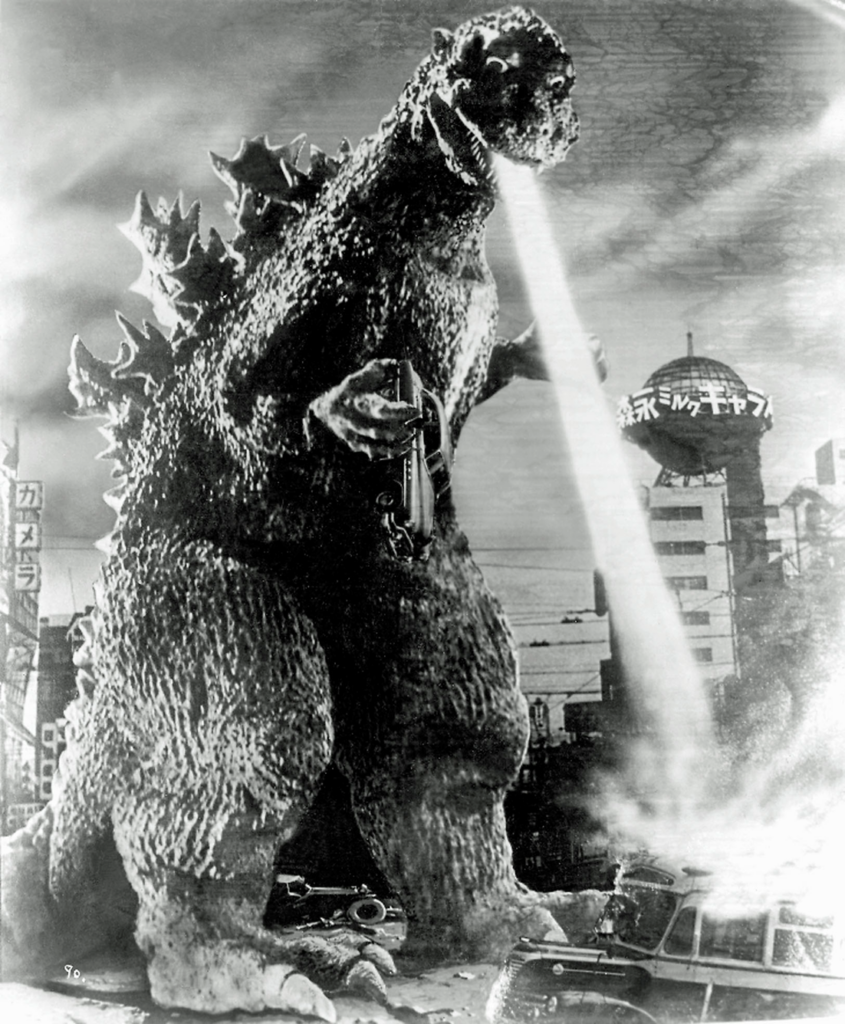
https://omniversal-battlefield.fandom.com/wiki/Godzilla_(1954)
In a multiplicity of views there is clarity. There are many ways to look at a movie either from the protagonist side, the antagonist or a detached observer. For a minute, I would like to put ourselves in the place of the monster from the original Godzilla film, Gojira, 1954. This is not the same film as the American version Godzilla King of the Monsters, 1956 which represents a campy bastardization of the original. In a clear case of art imitating life Gojira depicts serious content that serves as a warning over the dangerous effects of H-bomb testing relevant at the time. Why take the side of Godzilla? Because if we don’t we are in danger of missing the lesson he is trying to teach. A monster warns us of impending doom. This is not an inevitable scenario. We have a way of escaping; otherwise, the warning has no meaning. This cautionary tale is meant for us to change our way. To repent from bomb building before it’s too late. A monster always brings hope that we are not too far gone. The message Godzilla presents is as simple as it is sublime, respect nature, for as much as we think we have dominated, we are equally dependent on her for survival. Godzilla brings karmic balance which has up to now been a rout. He is everything we fear that will come upon us as a result of natural disaster: flood, tsunami, earthquake, uncontrollable fire, pandemic and relentless war. Most of all he represents divine punishment for carelessly splitting the atom. The movie is a protest over nuclear bomb testing. The movie was inspired by the results of H-bomb testing in 1954 and the poisoning of the Japanese fishing trawler Lucky Dragon no. 5, which was in the wrong place at the wrong time, covered in radioactive ash its crew members suffered radiation sickness and one eventually died. The movie is set against the background of Hiroshima and Nagasaki. Director Ishiron Honda used the wreckage of Hiroshima as the setting for Godzilla’s rampage through Tokyo. The original film has references to the atomic holocaust that were later cut from the American version, especially the last telling scene that warns if H-bomb testing does not cease the world will suffer from the return of Godzilla.
The creature was awoken by H-bomb testing in the South Pacific. The monster was peacefully hibernating in his underwater lair for millions of years when he was rocked by the nuclear blast. The beast was horribly wounded, covered in keloid-like scares over his whole body. Honda was taking the effects of radiation poison and applying them to the monster, which represents technology’s devastating effects on nature. Godzilla is a living H-Bomb. He wreaks a terrible vengeance for the destruction of his native habitat. In subsequent films he’s returning to his original breeding grounds in Japan only to find it desecrated with urban development, high tension wires and petroleum tanks. Godzilla cleans house with his powerful atomic ray which levels everything it touches. Despite all the carnage we tend to forget Godzilla was a victim too. His actions are in self-defense; don’t the laws of war apply equally to him or are we guilty of speciation that devalues all life except our own? Godzilla is reclaiming for Mother Nature what was lost through human progress. The monster’s perspective is one of anger and fury at his displacement and eviction from his natural environment.
The actions of a few affect the many. Nuclear scientists represent all people and from Godzilla’s POV all mankind must pay. This is a struggle of species dominance over the earth. This is a fight to the death. The monster has been made homeless and disfigured. He has been shot at, bombed and electrocuted and when this wasn’t enough an even more horrible weapon was deployed against him the oxygen destroyer, which ultimately ended his suffering. Humanity narrowly averted extinction perhaps for the last time.

Are the Jews or the Arabs the chosen people? Who is committing genocide, ethnic cleansing and holocaust? The Arab-Israeli Conflict will define the future of civilization, for the rest of the 21st century. The future of history hangs on whose claim is just? Who has entitlement to the land, especially Jerusalem? The Jews recite the Torah. The Muslims recite the Koran, the Christians hopefully recite the Sermon on the Mount and stay out of it. In any case they all have a commonality. They are scriptural religions, and legalistic; everything is by the book, they believe in the letter of the law; if the bible says stone the criminal or adultery. Thats what they will do and have no qualms about it. This also includes ownership over the holy land demanded by the Koran and given in the Torah. This is real estate at stake. We are standing on holy ground.
Only in Jesus Christ due we find liberation not in the worship of a literal book, scroll, paper, parchment or the place that it represents. I once threw my bible on the ground in class to demonstrate that Jesus is the Living Word, the bible is only a witness, the written word, inerrant only in the original autographs. We scribble all over our bibles and underline the text and make notes. Muslims would never do that to the Koran, the text must stay fresh. A leather-bound bible made of acid free paper will last hundreds of years. But our paper back bibles begin to disintegrate after forty years. Do we bring corruption to the Word of God by having sloppy and literally corrupt bibles? This is a rhetorical question. This does not deny the bible’s authority to speak to us. We are still accountable to its message whenever we hear it. The stories of drama in bible are not yet finished. A literal bible would have a literal interpretation. The grass of the field will be burned up but the Word of God will never perish. This was a teaching trick I learned from reading Zen Buddhism, except they used to burn the Buddhist scriptures and deface statues for effect.
The Muslim are bibliophiles, they adore a hard copy of the Koran. The Koran is literally recited and worshiped. In Muslim belief holy scripture and that includes the bible must never touch the ground. That would pollute its glory. And the Jews venerate the Torah. Biblical Literalism is at the heart of the Arab-Israeli Conflict. Faith salvation, however or salvation according to the Spirit, not the letter of the law brings the drama of the bible to fulfillment of prophecy in the reconciliation between Jews and Gentiles. The Jews and Arabs may destroy each other over whose interpretation of the bible is correct? Who has the real written scroll? Imagine a nuclear war over who has rights to the holy land over whose interpretation of the bible is correct? Doesn’t this prove that we still live within biblical times or at least the middle-ages? Modernity that is the belief that technology is brining us it a new age of global cooperation is a lie and we are just as malevolent today as they were in the first century, or the Stone Age. Proof positive that there is no such thing as inevitable or technological progress in history. We are right back to where we began.